
Contemporary Cosmology
Introduction
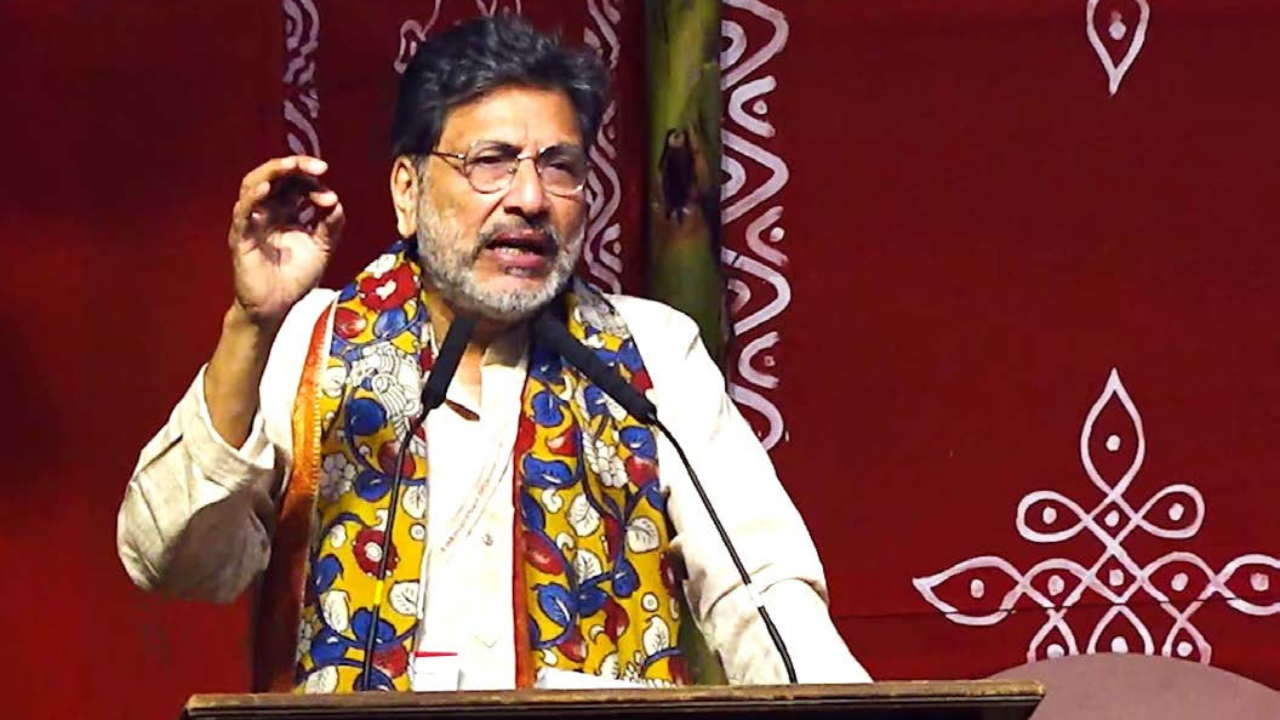
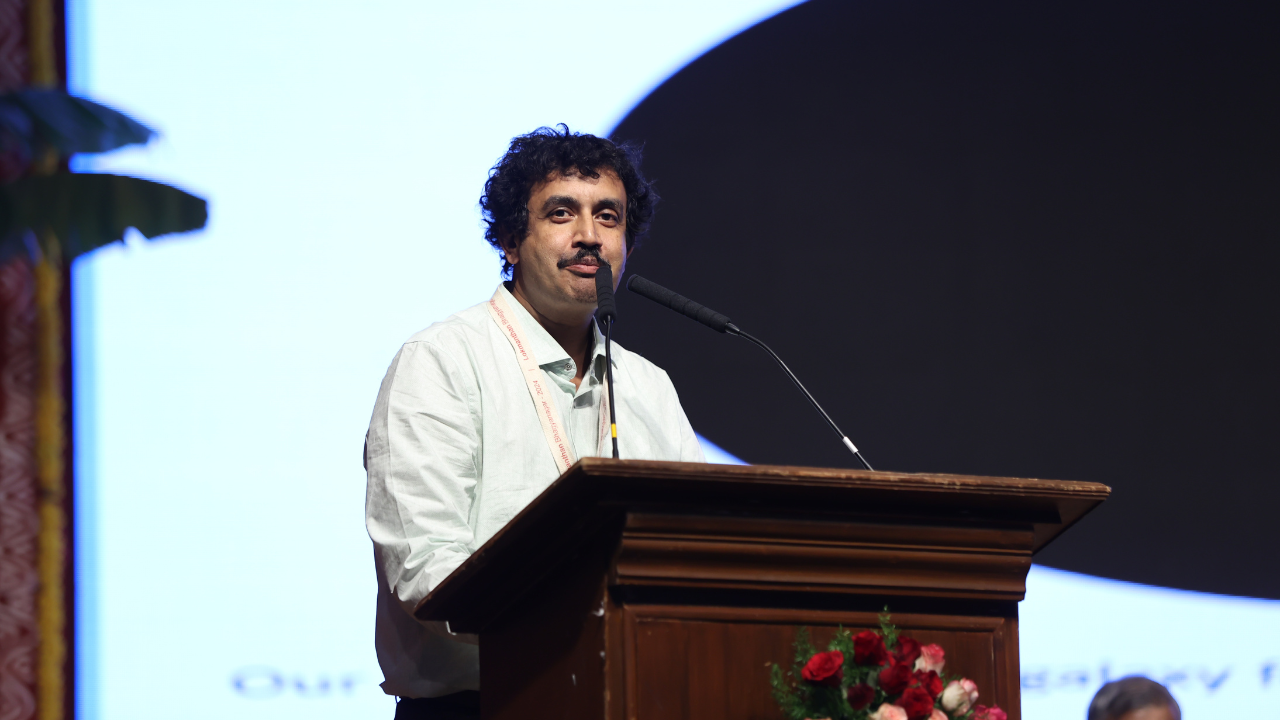
First of all, I would like to thank all the organisers and I am really grateful. I had never heard of Prajna Pravah and it’s truly an honour to be here. I wanted to express my gratitude to the Honourable Governor of Gujarat and Prof. Neerja Gupta of Gujarat State University for inviting me. In a few hours, I will have to catch a flight, so please excuse me so that I will go through a rapid round. As a Bengali, I will not speak in Hindi, as you may not find our Hindi easy to understand. I think English would be better. Since childhood, I have been hearing how great we were, how much knowledge we had and how we are slowly forgetting it. I wanted to do something different. I wondered if we could apply our principles or knowledge to create technologies that could make 300 years of Western civilisation redundant, paving the way for an unparalleled future civilisation. What I will share with you today encapsulates a journey of over 25 years towards this aim.
The Glass of Water Analogy
In front of you, you see a glass of water. If I say that each of you resembles a glass of water, would you believe it? After all, 77% of your body is water. I represent this with water, oil, salt and proteins-shake it up and you have a blend. You, who contemplate the mysteries of the universe, are composed of this simple mixture. There is a vast universe out there; if you venture far enough, there are 400 million black holes, with just one galaxy among them. This contrast rings true for both the smallest particles and the largest cosmic structures. To me, Hinduism represents a quest to understand the universe—from the smallest to the largest— identifying the origins of existence and implementing this understanding across our lives and culture.
The Journey of Discovery
We began our exploration from the smallest to the largest, measuring different masses. If I consider myself, I can analyse my organs, delve into cells and explore proteins down to the atoms. This journey extends infinitely. Regardless of where you start, potentially, a common ‘point’ can be found at either end. We plotted mass against surface area, using radius, across a spectrum that spans from elementary particles to colossal black holes. This approach led us to the understanding of the ‘Maharshi Kapila’ concept, which highlights the difference between Western scientific thought-often linear in its approach to time (past, present, future)-and our understanding, which perceives time as circular.
Architectural Implications
Today, I will highlight some implications of this architectural viewpoint. “As many worlds as there are outside, so many are within the self,” as seen in Yoga Vashishta. Our study revealed insights regarding tensors, which have been used consistently in the Western world for over 200 years but have roots in ancient Indian practices. While Western science operates on sequential principles, our understanding encompasses a traveling journey that includes the inner and the above. Hence, we have developed mathematical tools over the past decade that is designed to analyze and implement Vedic concepts.
Seeking Cosmic Truths
An example of this is quantum chromodynamics, which was inspired by Maharshi Kapila , asserting the existence of three colors from which all matter can be formed. We can also see cycles of time in the cyclic universe theory, which Einstein adopted in the 1930s—an instance reflected in our scriptures. We aim to view time as a multi-dimensional construct, similar to space, which could potentially include additional dimensions beyond what we currently conceive.
Sankhya Philosophy
The Sankhya philosophy elucidates that everything can indeed be explained through numbers. However, Maharishi Kapila’s student, Arushi, countered this notion, emphasizing the necessity of exploring beyond mere numeric interpretations into the dimensions of reality. In Western intellectual thought, time has traditionally been linear-three dimensions of space and one dimension of time. Yet, in Vedic philosophy, time comprises three dimensions, contemplating the duality of Purusha (consciousness) and Prakriti (matter).
Findings from Neuroscience
In my earlier research, I delved into human consciousness, specifically measuring neurons and published findings related to the Triplet Neurons exhibit vibrational patterns that are often overlooked in Western science, which tends to consider singular time domains. We demonstrated that life is more intricate than that, functioning across multiple time frames.
Groundbreaking Discoveries
Our findings came to fruition during collaboration with NASA, where we investigated the asteroid belt between Mars and Jupiter. We uncovered helical structures within the universe that resonate with ancient Indian wisdom. While conducting experiments, we identified neuron activity patterns that challenge the norms of neuroscience—our results indicated unusual patterns, including megahertz bursts during unconscious states.
Architectural Applications
Moving forward to one significant architectural insight, I wanted to showcase the mathematical framework of temple design. The arrangements possible within a set of numbers, especially when examined through the perspective of Maharishi Kapila’s work, echo our ancient wisdom. This led to a proposal for quantum computing and further exploration into how these ancient principles could inform future technological advancements. We aim to redefine architectures that connect deeply with Purusha and Prakriti, invoking several dimensions of understanding.
Conclusion and Future Directions
As we create constructs informed by these principles, we can build systems that resonate with ancient Indian knowledge. I am excited to state that any researchers focused on the Indian knowledge system will have access to our resources, research tools, and databases for free; just reach out to me or Prof. Neerja Gupta Ma’am. Ultimately, our aim is to merge ancient wisdom with contemporary science, acknowledging that our civilization provided the foundation for many of the modern scientific advancements and continues to inspire future discoveries.
Thank you all for being part of this journey today!
“in Vedic philosophy, time comprises three dimensions, contemplating the duality of Purusha (consciousness) and Prakriti (matter).”
– Dr. Anirban Bandyopadhyay
Senior Scientist – NIMS, Japan
First of all, I would like to thank all the organisers and I am really grateful. I had never heard of Prajna Pravah and it’s truly an honour to be here. I wanted to express my gratitude to the Honourable Governor of Gujarat and Prof. Neerja Gupta of Gujarat State University for inviting me. In a few hours, I will have to catch a flight, so please excuse me so that I will go through a rapid round. As a Bengali, I will not speak in Hindi, as you may not find our Hindi easy to understand. I think English would be better. Since childhood, I have been hearing how great we were, how much knowledge we had and how we are slowly forgetting it. I wanted to do something different. I wondered if we could apply our principles or knowledge to create technologies that could make 300 years of Western civilisation redundant, paving the way for an unparalleled future civilisation. What I will share with you today encapsulates a journey of over 25 years towards this aim.
The Glass of Water Analogy
In front of you, you see a glass of water. If I say that each of you resembles a glass of water, would you believe it? After all, 77% of your body is water. I represent this with water, oil, salt and proteins-shake it up and you have a blend. You, who contemplate the mysteries of the universe, are composed of this simple mixture. There is a vast universe out there; if you venture far enough, there are 400 million black holes, with just one galaxy among them. This contrast rings true for both the smallest particles and the largest cosmic structures. To me, Hinduism represents a quest to understand the universe—from the smallest to the largest— identifying the origins of existence and implementing this understanding across our lives and culture.
The Journey of Discovery
We began our exploration from the smallest to the largest, measuring different masses. If I consider myself, I can analyse my organs, delve into cells and explore proteins down to the atoms. This journey extends infinitely. Regardless of where you start, potentially, a common ‘point’ can be found at either end. We plotted mass against surface area, using radius, across a spectrum that spans from elementary particles to colossal black holes. This approach led us to the understanding of the ‘Maharshi Kapila’ concept, which highlights the difference between Western scientific thought-often linear in its approach to time (past, present, future)-and our understanding, which perceives time as circular.
Architectural Implications
Today, I will highlight some implications of this architectural viewpoint. “As many worlds as there are outside, so many are within the self,” as seen in Yoga Vashishta. Our study revealed insights regarding tensors, which have been used consistently in the Western world for over 200 years but have roots in ancient Indian practices. While Western science operates on sequential principles, our understanding encompasses a traveling journey that includes the inner and the above. Hence, we have developed mathematical tools over the past decade that is designed to analyze and implement Vedic concepts.
Seeking Cosmic Truths
An example of this is quantum chromodynamics, which was inspired by Maharshi Kapila , asserting the existence of three colors from which all matter can be formed. We can also see cycles of time in the cyclic universe theory, which Einstein adopted in the 1930s—an instance reflected in our scriptures. We aim to view time as a multi-dimensional construct, similar to space, which could potentially include additional dimensions beyond what we currently conceive.
Sankhya Philosophy
The Sankhya philosophy elucidates that everything can indeed be explained through numbers. However, Maharishi Kapila’s student, Arushi, countered this notion, emphasizing the necessity of exploring beyond mere numeric interpretations into the dimensions of reality. In Western intellectual thought, time has traditionally been linear-three dimensions of space and one dimension of time. Yet, in Vedic philosophy, time comprises three dimensions, contemplating the duality of Purusha (consciousness) and Prakriti (matter).
Findings from Neuroscience
In my earlier research, I delved into human consciousness, specifically measuring neurons and published findings related to the Triplet Neurons exhibit vibrational patterns that are often overlooked in Western science, which tends to consider singular time domains. We demonstrated that life is more intricate than that, functioning across multiple time frames.
Groundbreaking Discoveries
Our findings came to fruition during collaboration with NASA, where we investigated the asteroid belt between Mars and Jupiter. We uncovered helical structures within the universe that resonate with ancient Indian wisdom. While conducting experiments, we identified neuron activity patterns that challenge the norms of neuroscience—our results indicated unusual patterns, including megahertz bursts during unconscious states.
Architectural Applications
Moving forward to one significant architectural insight, I wanted to showcase the mathematical framework of temple design. The arrangements possible within a set of numbers, especially when examined through the perspective of Maharishi Kapila’s work, echo our ancient wisdom. This led to a proposal for quantum computing and further exploration into how these ancient principles could inform future technological advancements. We aim to redefine architectures that connect deeply with Purusha and Prakriti, invoking several dimensions of understanding.
Conclusion and Future Directions
As we create constructs informed by these principles, we can build systems that resonate with ancient Indian knowledge. I am excited to state that any researchers focused on the Indian knowledge system will have access to our resources, research tools, and databases for free; just reach out to me or Prof. Neerja Gupta Ma’am. Ultimately, our aim is to merge ancient wisdom with contemporary science, acknowledging that our civilization provided the foundation for many of the modern scientific advancements and continues to inspire future discoveries.
Thank you all for being part of this journey today!
“in Vedic philosophy, time comprises three dimensions, contemplating the duality of Purusha (consciousness) and Prakriti (matter).”
– Dr. Anirban Bandyopadhyay
Senior Scientist – NIMS, Japan