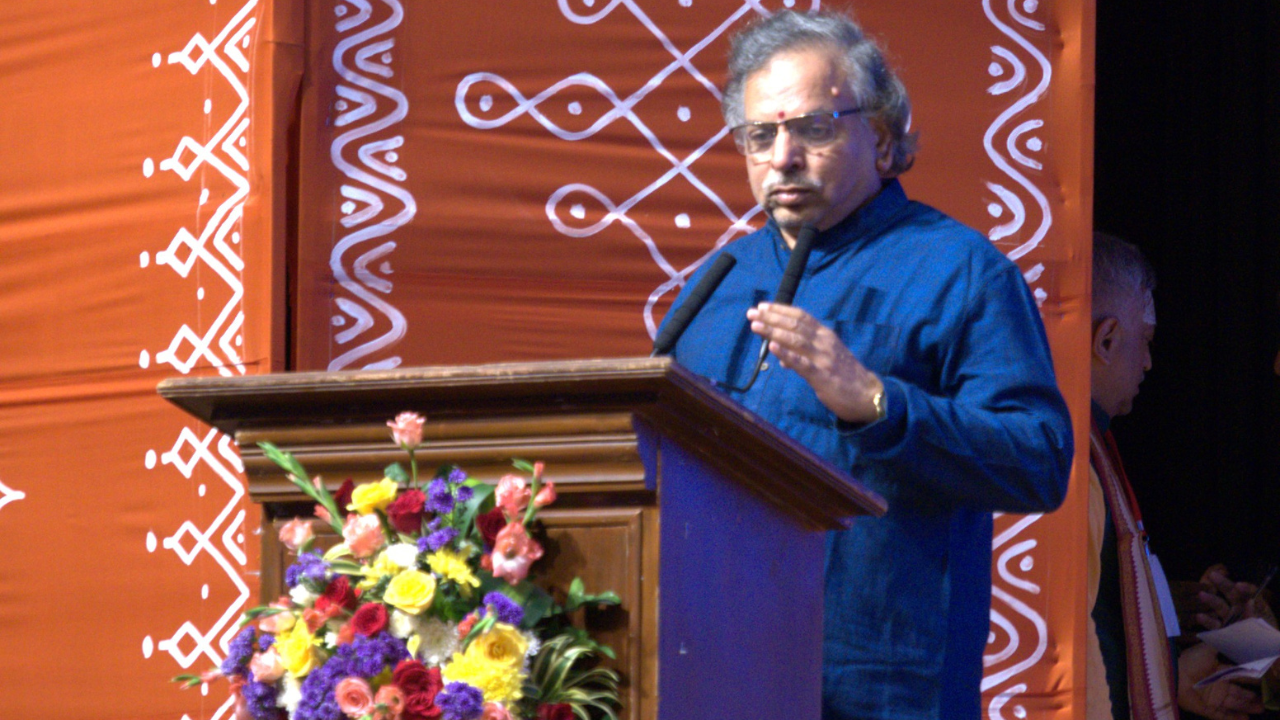


A Glimpse into Ancient India’s Scientific Traditions and Knowledge Practices
Prof. Neerja A. Gupta
Vice-chancellor, Gujarat University
Namaste and respectful greetings to the chairperson of this session, the Honorable Governor of Gujarat State, His Excellency Shri Devvrat ji-the Chancellor of the university I represent—my fellow panelist Shri Anirban, and all the esteemed brothers and sisters present in this auditorium. I understand that time is limited, so I will keep my remarks brief. Interestingly, the thoughts I had prepared align well with the points raised by His Excellency and Anirban earlier.
The Dichotomy Between High-Brow and Low-Brow Science in Indian Society
Indian society often divides science into ‘high-brow’ and ‘low-brow’ categories. Those who work in laboratories and use complex formulas are regarded as scientists, while those who apply science in everyday life are often overlooked. Practices such as faith, devotion, and rituals, though deeply rooted in science, are frequently dismissed.
What Anirban shared in his presentation inspires me to highlight a concept that I believe represents the science of the people, conveyed through the simple yet profound five-syllable mantra.
The Scientific Significance of the Panchakshari
The Panchakshari Mantra, Om Namah Shivaya, holds profound scientific significance. As Anirban mentioned and as my studies also suggest, the Earth rotates clockwise while the universe rotates counterclockwise. This creates sound vibrations in the universe, which, in sound engineering, are referred to as “the opposite.” NASA has acknowledged that the sound of “Om” can be heard in space. However, our ancient sages had already internalized this sound and were chanting “Om” long before such discoveries. The five syllables in Om Namah Shivaya represent the five elements. Unlike other cultures that speak of four elements, India acknowledges five—earth, water, fire, air, and space.
Chakras, Energy Flow and Detoxification
Our body is composed of seven chakras, five of which lie below the throat and two above. The energy within us flows upwards. As His Excellency mentioned, there are three gunas: Sattva, Rajas and Tamas. The chakras correspond to the five elements:
Muladhara: Earth (black)
Swadhishthana: Water
Manipura: Fire
Anahata: Air
Vishuddha: Space.
When we chant Om Namah Shivaya, these five elements within us are detoxified. The chakras act as energy centres where thousands of nadis (energy channels) converge. Purifying these chakras purifies the nadis, allowing energy to flow freely through the body. This is why we chant the Panchakshari Mantra 108 times. The two upper chakras-Ajna and Sahasrara-represent the upward-moving prana. These can only ascend when the lower chakras are cleansed and functioning properly. Therefore, chanting Om Namah Shivaya regularly helps maintain a balanced and scientifically beneficial flow of energy in the body.
The Body as a Microcosm of India
Indian scientists often compare the human body to a nation. Just as our body has chakras, the country too has spiritual centers. For example, the Sapta Sindhu lies at the base, and at the top lies Adi Kailash, representing space. The journey from Kanyakumari to Adi Kailash, passing through the seven Prayags, mirrors the purification process of our nadis. This deep connection between the body and the land forms part of the scientific wisdom passed down through generations.
Indigenous Agricultural Practices: Soil Testing and Predictive Science
His Excellency spoke of agriculture, and I would like to add a point. During Navratri, we engage in a practice that exemplifies our indigenous soil testing. We take a pot, fill it with soil, sow grains, and place a lamp on top. This simulates the environment in which seeds grow. Over nine nights, we observe the growth, and on the tenth day, we determine the potential harvest. This practice is an indigenous form of soil testing, predicting the upcoming harvest without the need for modern laboratories. The pots collected from villages were taken to the temple, which acted as a data center. Based on these results, the king would adjust his taxation policies-an early form of predictive agriculture.
The Predictive Wisdom of Navratri
Navratri also holds predictive value. The vehicle that Goddess Durga rides upon during Navratri signifies key predictions about the economy, health, and potential threats in the coming year. These predictions, made using ancient systems, illustrate our rich, indigenous strategic political knowledge.
Folk Wisdom: Preserving India’s Scientific Tradition
From childhood, we were given important health advice, such as:
“Do not eat jaggery in Chaitra, oil in Baisakh, path in Jyeshtha, bel in Ashadha, greens in Shravan, curd in Bhadrapada, milk in Kartik, cumin in Paush, and sugar in Magh.” This is an example of folk science—age-old wisdom that has contributed to the survival and flourishing of Indian culture and civilization.
Conclusion
Though the topic is vast and fascinating, I will conclude here due to time constraints. Thank you all for your attention.
“Unlike other cultures that speak of four elements, India acknowledges five: earth, water, fire, air, and space.”
– Prof. Neerja A. Gupta
Vice-chancellor, Gujarat University